
When a father can’t be there, it’s tempting to say, “He is gone,” but is he, really?
I could say that my father, Norman Lester Brown, passed away. But his words, his ways, his stories come to mind so often that a more truthful thing to say is, “He is always with me.”
And I could say that my father died of lung cancer metastasized to the bone some 14 years ago, but, since half his DNA floats around in each of my living cells, and a quarter of his DNA makes up the genes in each of my daughters’ living cells too, “dead” hardly seems like the right way to put it, either. I retell to my daughters the things he told me many a time, when I don’t know quite what to say.
He and my mother made me; he and my mother shaped me. I am, because they gave me everything I needed to survive before I could ask for it, demand it, or work for it. I like to think that I’m like him in some ways, and in a photos from when we were about the same age, him in 1945 and me in 1980, I imagine that I resemble him.

The Father Enigma
When I was very young, before I had started school, I remember asking my mother why we need a father.
“God wouldn’t let me have you without a father,” she said.
She was cooking at the table and I was in some kind of high wooden chair beside her close to the kitchen window — still a toddler. I looked out the window at his garage workshop there down the hill from the house, which is where he usually was during my waking hours. At the time, I was certain God made a big mistake there, because my mother was the one always with me. Always talking with me, feeding me, bathing me, and I hardly ever saw my father since he came in after my bedtime.
He seemed to be not the least bit interested in my early childhood foolishness.
As I got older, I came to understand the essential, supportive, grounding role he carried on for each of us in our little family. But when I was a child, my father and I didn’t have much of what you would call conversation.
“Little girls are to be seen and not heard,” was a well-meaning comment I heard from him way too often for my liking.
To be sure, I was annoying, and yet he never seemed angry with me. I talked constantly when I had the chance. Sometimes, more directly, he would simply tell me to be quiet because he was listening to the news, or the opera, or reading the paper, or The New Yorker, or Sciences – and if I kept on, he couldn’t do any of those things.
I listened to him. I watched him. I followed him around as he was working. My father became a subject of observation, and later, of fascination.
Father, the Strong Man

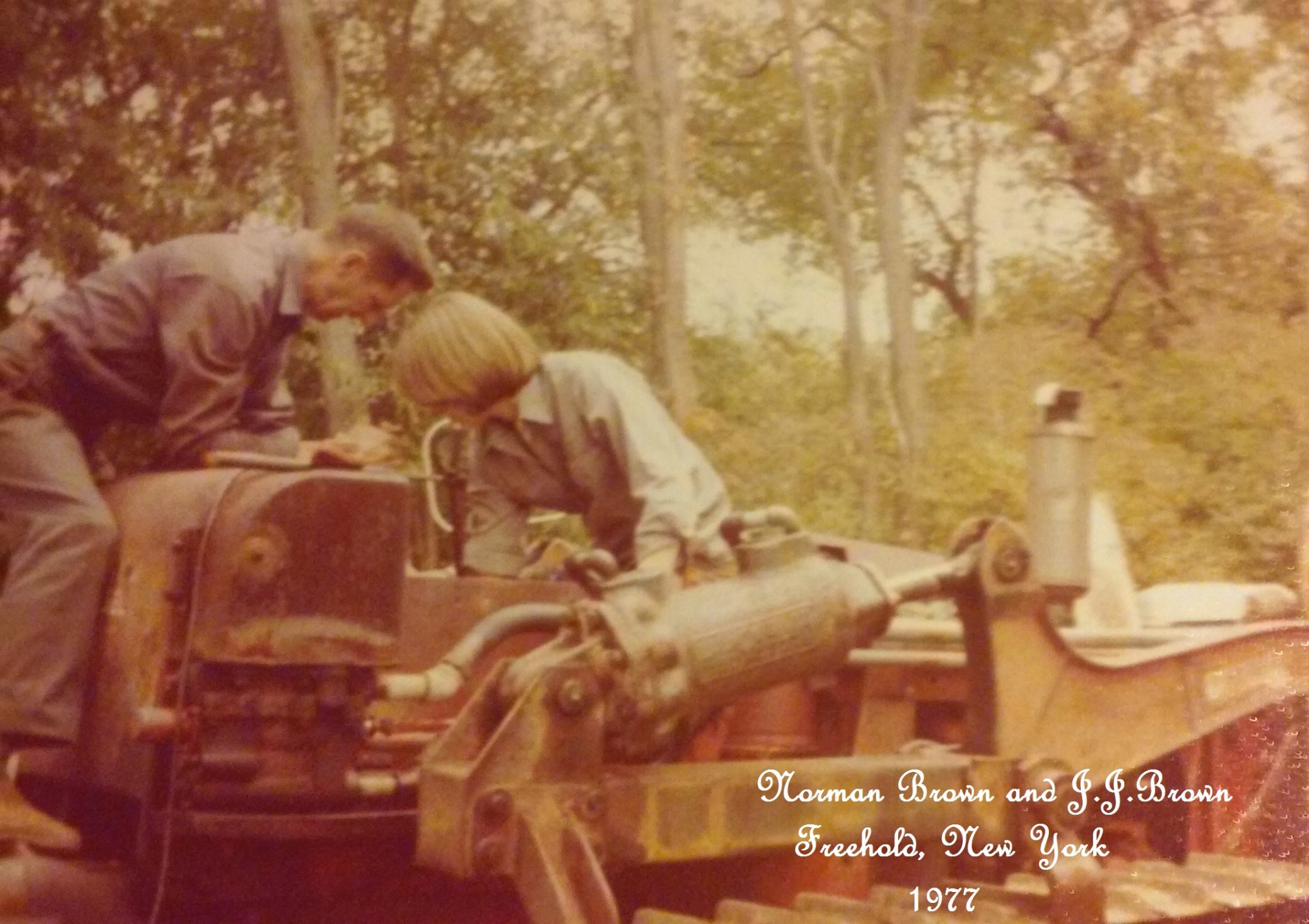
As I remember him, Norman Brown was over six feet tall, slim, and iron clad in muscle. He kept his black hair very short. His face was clean-shaven, and he had large blue eyes with perfect eyesight. His were steady hands with any kind of tool. He was masterful with machines, some of which he invented and put together out in his garage. He was always fixing or rebuilding all types of vehicles too — anything from motorcycles to sports cars to bulldozers.
My Father, the Storyteller
My father was also a storyteller. When he was in the mood, and I was still awake, he retold all kinds of stories, from Norse myths, to opera plots, to Isaac Bashevis Singer stories. He also told tales from his past. How even as a child, he was always working. How he drove a truck loaded with potatoes in and out of New York City before he started high school — too young to legally drive. How he had to cut school many a day to work on the small farm and fields surrounding the house I later grew up in a long with my sister.
At 18, he volunteered for the U.S. army after his stepbrother, who had been drafted, was killed in Germany. His stepmother couldn’t stop either one of them. In basic training in Texas he found out that nothing could motivate him to kill a stranger, someone he didn’t know, who had a family, who might be much like he was – as he explained it to us. He suffered through many a psychiatric investigation trying set him right as a good soldier. Finally, the army gave up on training him and he was used to stand guard outside General MacArthur’s tent in the Philippines, and later in Japan, to cart away the dead and bring food to survivors.
One of the many important things my father taught me was to be in the moment — because what was right and wrong, truth or lie, was always relative to the context of that one moment.
So here, now in this moment, the truth is Norman Lester Brown is very much with me for Father’s Day not only in memories, but in how I see and live in my world every day.
I write about missing a father’s love in two of my published novels, American Dream, and Vector, a Modern Love Story. Read more about these at my books page.
Share your views with readers!